

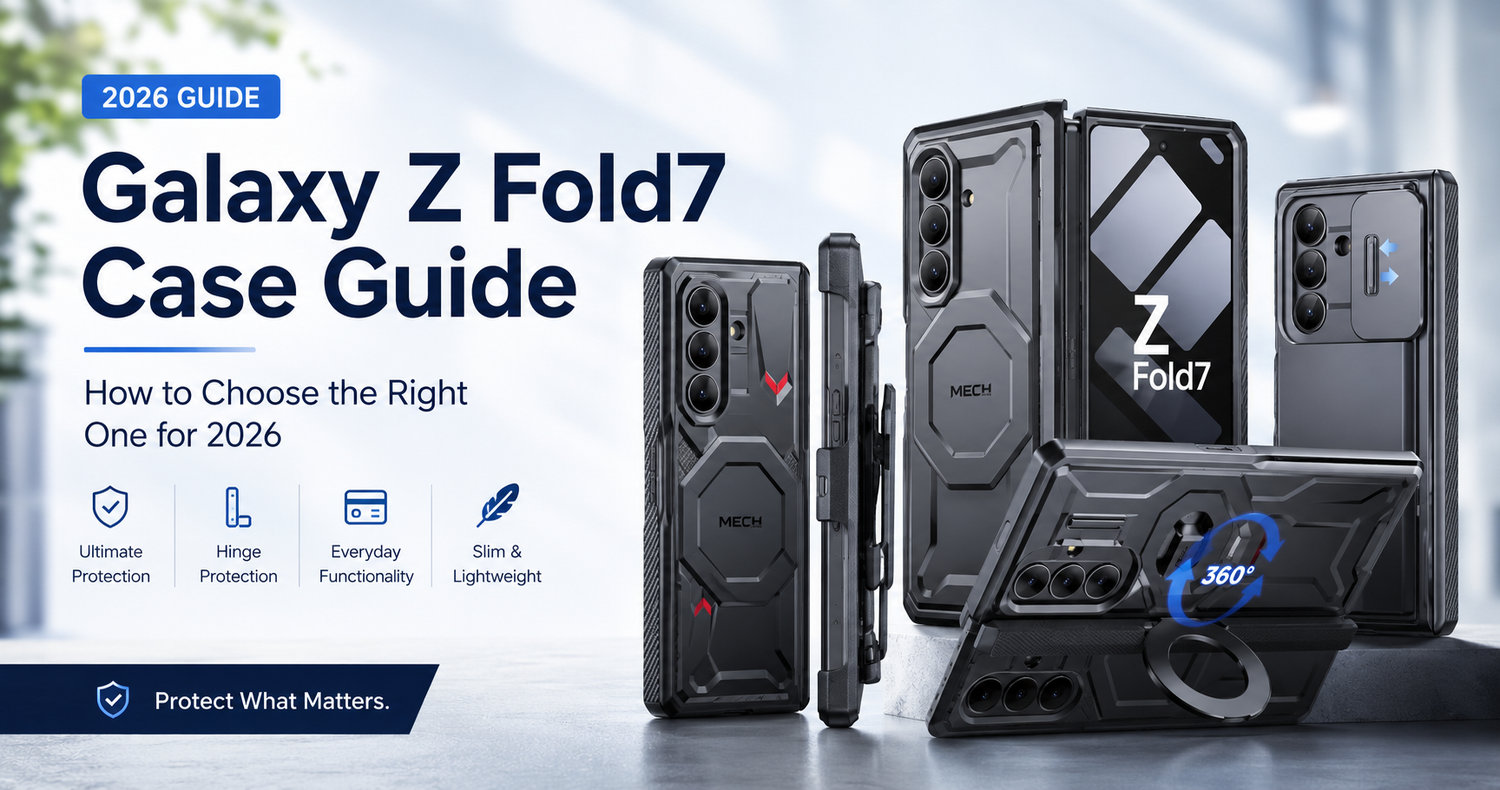
If you've just picked up a Galaxy Z Fold — or you're eyeing one — you already know it's not like buying a case for an iPhone or a Galaxy S. A foldable has a hinge, two screens, and a crease that can't be undone. Get the wrong case, and you're not just risking a scratch; you're risking a $1,800 repair bill. In this guide, we'll break down what makes the Fold series unique, why case selection matters more here than on any other phone, and how to actually pick the right Galaxy Z Fold7 case for how you use your phone.

1. Meet the Fold Series — and Why the Z Fold7 Is the One to Beat
Samsung's Galaxy Z Fold line has been through seven generations, and the story of those generations is really the story of the phone slowly disappearing — getting thinner, lighter, and less compromised every year. The Galaxy Z Fold7, announced in July 2025, is widely considered the most refined version yet, and for good reason.
Key Z Fold7 specs:
- Displays: A 6.5-inch outer Cover Screen (2520 × 1080, 21:9 aspect ratio) and an 8.0-inch inner main display (2184 × 1968), both Dynamic AMOLED 2X panels. The cover screen is noticeably wider than on the Fold6, so it finally feels like a normal phone when closed.
- Build: This is the headline change. At just 8.9mm folded and 4.2mm unfolded, the Fold7 is dramatically slimmer than the Fold6 (12.1mm / 5.6mm) — and at 215 grams, it's actually lighter than the Galaxy S25 Ultra.
- Chipset: A Snapdragon 8 Elite processor customized for Galaxy, delivering a big jump in speed and AI performance over the Fold6's Snapdragon 8 Gen 3.
- Cameras: A 200MP main sensor, 12MP ultra-wide, and a 10MP 3x telephoto lens, plus dual 10MP selfie cameras (one on each screen).
- Battery: A dual 4,400mAh cell.
- Durability upgrades: A new Armor Aluminum frame, Corning Gorilla Glass Ceramic 2 on the cover screen, Gorilla Glass Victus 2 on the back, and a redesigned Armor FlexHinge with a multi-rail structure meant to reduce visible creasing and spread stress more evenly.
- One notable change: Samsung dropped S Pen support entirely on the Fold7 — more on why that matters for case-shopping below.
The takeaway: Samsung shaved millimeters and grams off this phone in almost every direction. That's fantastic for how the Fold7 feels in your hand — and it's exactly why the case conversation is so important.

2. Why the Fold Series Needs a Case More Than Any Other Phone
With a normal slab phone, a case is mostly about scratches and drop protection for a single sheet of glass. A foldable has several extra points of failure that a case has to think about:
- The hinge is mechanical, not solid-state. It's the single most expensive component to repair, and it's exposed on the outside of the device every time you fold it.
- The inner screen is a flexible, ultra-thin glass/polymer sandwich, not standard glass — it's far more vulnerable to punctures, grit, and pressure than a normal display.
- The crease area collects dust and debris over time, which can work its way into the folding mechanism if it isn't shielded.
- Thinner and lighter also means less material margin. The very changes that make the Fold7 so pleasant to hold — the shaved-down aluminum frame, the slimmer hinge — also mean there's simply less phone there to absorb an impact compared to a slab flagship.
- Two screens means two chances to crack something when the phone is closed and lying camera-side down, or open flat on a desk.
In short: a bare Fold7 is a beautiful piece of engineering with very little tolerance for accidents. This is why "do I even need a case" isn't really a live question with this phone the way it might be for a Galaxy S or iPhone — for the vast majority of Fold owners, a case isn't optional gear, it's a structural part of owning the phone.
3. The Feature Landscape: What Actually Differs Between Fold Cases
Hinge protection
Some cases wrap a rigid or semi-rigid guard around the hinge itself (often called a "flat hinge" or "hinge cover" design); others leave the hinge bare and only protect the two body halves. Hinge-covered cases:
- Guard against dust and grit working into the mechanism
- Add a raised lip that keeps the two screens from directly touching each other when folded, which reduces crease stress and scratch risk
- Can add a small amount of thickness and sometimes a very slight "seesaw" feel when folding, though modern designs (like flat, multi-rail hinge covers) have mostly engineered this out
Cases without hinge coverage tend to be slimmer and closer to the phone's original profile, but leave the single most repair-expensive part of the phone exposed.
Pen/stylus storage
Here's an important nuance a lot of shoppers miss: the Galaxy Z Fold7 does not support the S Pen. Samsung removed the digitizer layer that senses an active stylus starting with this generation — the Fold6 was the last model with true S Pen support. No Fold phone has ever had a built-in pen silo the way the S Ultra line does, so if you're used to carrying an S Pen with a Fold6 or earlier, that workflow doesn't carry over.
What you'll find on the market for the Fold7 falls into two very different buckets:
- Genuine holder cases for a passive capacitive stylus — these have a real slot and can hold a basic touchscreen pen for writing or sketching, but it's a passive tool, not the pressure-sensitive S Pen experience.
- Listings that reuse "S Pen case" marketing language loosely — worth reading carefully before you buy, since "S Pen compatible" on a Fold7 listing sometimes just means "doesn't block the screen," not "has real pen storage."
If pen input matters to you, look specifically for a case that shows an actual pen slot in its product photos, and confirm whether it's for a passive stylus rather than an S Pen.
Card/wallet storage
A growing number of Fold cases build a card holder into the back panel — usually good for 1–3 cards, sometimes doubling as a kickstand. This is a genuinely nice option on a phone this size, since the Fold7 is already replacing a tablet in your bag; some people like consolidating a card or two onto the phone itself instead of carrying a separate wallet.
Kickstands
Given the Fold7's tablet-like inner display, several cases add a built-in, often rotating kickstand — handy for video calls, watching content, or using Flex Mode (the split-screen feature that activates when the phone is partially folded).
Magnetic (MagSafe-style) compatibility
Many newer cases build in a magnetic ring compatible with Qi2/MagSafe-style chargers, mounts, and wallets, letting you snap on accessories without giving up wireless charging.
Materials and rigidity
You'll see everything from ultra-slim clear PC/TPU shells (closest to no case at all) to rugged, MIL-STD-810G-rated armor cases with raised camera bumpers, to leather-wrapped wallet-style flip cases for a more premium, business-oriented look.
4. How to Choose the Right Case for Your Fold7
There's no single "best" case — the right pick depends entirely on how you actually use the phone. A few scenarios to place yourself in:
- "I use this phone for work and carry it everywhere, but I'm not rough on gear." A slim case with hinge protection and MagSafe-style compatibility is probably the sweet spot — protection where it matters most, without adding real bulk.
- "I've cracked a screen before" / "I work outdoors or on job sites." Prioritize a rugged, drop-rated case with full hinge coverage and raised camera bumpers, even if it adds some thickness. This is the closest thing to insurance you can buy at checkout.
- "I want to ditch my wallet." Look at the wallet-back or card-holder cases — just double-check the card slot doesn't interfere with wireless charging or NFC/tap-to-pay if you use it.
- "I use the inner screen for video calls or watching shows a lot." A case with an integrated, rotating kickstand pays for itself quickly.
- "I still want to sketch or take notes by hand." Go in with realistic expectations — you're shopping for a passive-stylus holder case, not a true S Pen replacement, since the Fold7's hardware no longer supports the digitizer.
- "I want it to still feel like a $1,800 phone." Leather-style flip cases or slim clear cases preserve the design language Samsung worked hard to slim down — just be honest with yourself about how much drop protection you're trading away for looks.
A practical habit: think about the one scenario that's most likely to actually happen to your phone (dropped in a bag with keys, face-down on a table, in a kid's hands for five minutes) and make sure your case is built for that specific risk, rather than trying to find a case that's simultaneously the slimmest, toughest, and cheapest — that case doesn't exist.
6. Frequently Asked Questions
Does the Galaxy Z Fold7 need a case? Yes. The Fold7's hinge is mechanical and expensive to repair, its inner display is a flexible glass/polymer panel far more vulnerable than standard phone glass, and the phone's thinner, lighter build leaves less material margin to absorb an impact than a standard slab flagship.
Does the Galaxy Z Fold7 support the S Pen? No. Samsung removed S Pen digitizer support starting with the Fold7 — the Galaxy Z Fold6 was the last model that supported an active S Pen. Cases marketed as "S Pen holder" cases for the Fold7 typically hold a passive capacitive stylus, not a true S Pen.
Do Z Fold7 cases cover the hinge? Some do and some don't. Hinge-covered cases add a raised lip that keeps the two halves of the screen from touching when folded and help keep dust out of the mechanism; hinge-free cases are slimmer but leave the hinge exposed.
Will a case affect Galaxy Z Fold7 wireless charging? Most modern Z Fold7 cases are designed to stay on during Qi wireless charging, including MagSafe-style magnetic cases — but always check the specific case's compatibility if you charge wirelessly often.
What's the best type of case for everyday Z Fold7 use? For most people, a slim case with hinge protection and magnetic (MagSafe-style) compatibility offers the best balance of protection and everyday usability. Heavier-use cases (job sites, kids, frequent drops) should prioritize a rugged, drop-rated case with full hinge coverage instead.
5. The Bottom Line
The Galaxy Z Fold7 is the thinnest, lightest, most "normal-feeling" Fold Samsung has ever built — and that refinement is exactly why the case you choose matters so much. Before you buy, get clear on three things: how much hinge protection you actually need, whether you want a genuine pen slot (and understand it'll hold a passive stylus, not an S Pen), and which extras — card storage, a kickstand, magnetic mounting — fit how you use the phone day to day. Get those three questions right, and you'll land on a case that protects the phone without undoing everything Samsung did to make it thin, light, and worth carrying in the first place.

Leave a comment
This site is protected by hCaptcha and the hCaptcha Privacy Policy and Terms of Service apply.