

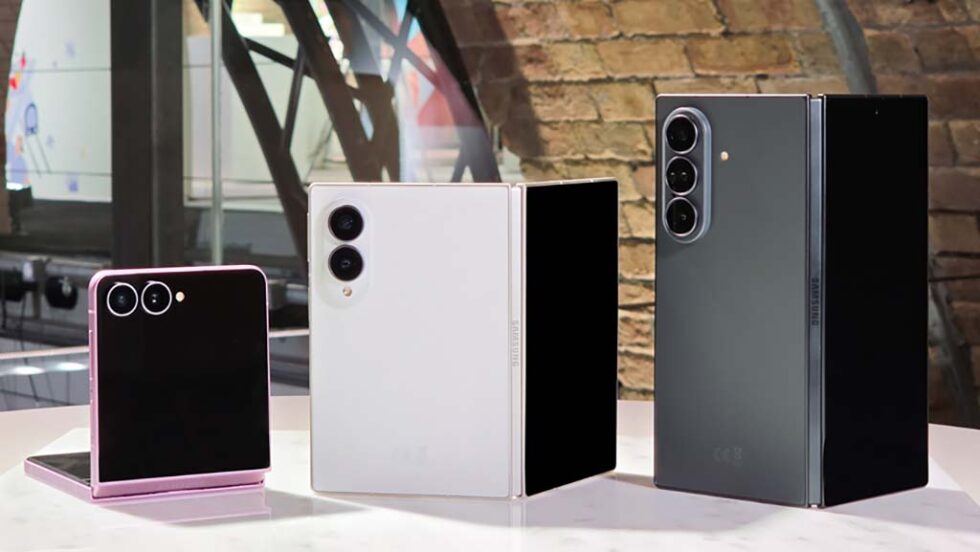
Samsung's summer 2026 Unpacked event — held in London for the first time instead of the usual New York or Seoul stop — introduced a genuinely different Fold lineup. Instead of one more incremental update, Samsung split the family into three devices: the Galaxy Z Fold8, the Galaxy Z Fold8 Ultra, and the Galaxy Z Flip8. If you've been holding onto a Fold5, Fold6, or even last year's Fold7, this is the first refresh in a while that changes the shape of the conversation rather than just the spec sheet.
Here's what's actually new, how the two Fold models compare, and a few things worth thinking about before you spend close to two thousand dollars on one.
A Passport-Shaped Redesign
The headline change isn't a chip or a camera — it's the body. Samsung is calling this its first "passport-style" foldable, meaning the closed form factor is shorter and wider than previous generations, closer to the proportions of a passport booklet than the tall, narrow slab Fold owners are used to.
Early hands-on impressions suggest this pays off in everyday use. Reviewers who expected the wider body to feel awkward in the hand instead found the weight distribution more balanced, with the phone feeling less top-heavy during one-handed use than the outgoing Fold7. The Fold8 also picked up boxier, flatter corners rather than following the industry's usual move toward big rounded edges — a small design choice, but one that gives the phone a distinct look on a shelf full of curved-corner flagships.
Weight and thickness break down like this:
- Galaxy Z Fold8: 201g, 4.5mm unfolded
- Galaxy Z Fold8 Ultra: 215g, 4.1mm unfolded
Both are meaningfully lighter than most previous-generation Folds, and both share the same flat-sided aesthetic and IP48 water/dust resistance rating.
The Hinge: "Flex Titanium" and a Nearly Invisible Crease
Samsung's foldables have always lived or died on the hinge, and this year the company leaned hard into a new approach it calls Flex Titanium. The idea builds on last year's titanium support plate by adding a second, ultra-thin titanium-alloy sheet directly beneath the display — reportedly about a third the thickness of a human hair — to keep the panel flatter across its lifespan.
The early payoff reviewers keep mentioning: after dozens of open-and-close cycles on demo units, the crease was described as nearly invisible on the standard Fold8, and barely noticeable on the Fold8 Ultra. Samsung is also backing the hinge with a rated durability of up to 500,000 folds.
There's also a new opening feel. Samsung calls it an "Easy Open-and-Close Mechanism," borrowed in part from the Korea-exclusive Galaxy Z TriFold. In practice, testers noted the first few millimeters of opening require noticeably less force than on the Fold7, which had a reputation for being stiff to crack open one-handed. One notable difference between the two models: the Fold8 Ultra gets a small finger groove between the panels to make that first separation easier, while the standard Fold8 does not.
One feature that didn't carry over to the standard model: Flex Mode, the laptop-style half-folded posture, remains exclusive to the Fold8 Ultra.
Specs at a Glance
| Galaxy Z Fold8 | Galaxy Z Fold8 Ultra | |
|---|---|---|
| Display (unfolded) | 7.6" | 8.0" |
| Cover display | ~6.5" | Larger cover panel |
| Chip | Snapdragon 8 Elite Gen 5 for Galaxy | Snapdragon 8 Elite Gen 5 for Galaxy |
| RAM | 12GB | 12GB |
| Storage | 256GB / 512GB / 1TB | 256GB / 512GB / 1TB |
| Battery | 4,800 mAh | 5,000 mAh |
| Cameras | Dual (50MP main + 50MP ultra-wide) | Triple (adds telephoto) |
| Weight | 201g | 215g |
| Thickness (unfolded) | 4.5mm | 4.1mm |
| Software | Android 17, One UI 9 | Android 17, One UI 9 |
| Starting price | $1,899.99 | Higher, Ultra tier |
The most-cited real-world omission on the standard Fold8 is the lack of a dedicated telephoto lens — reviewers noted that anything past 2x zoom on the main 50MP sensor starts to look soft. If long-range zoom matters to you, that's the clearest reason to look at the Ultra instead.
Both phones run Android 17 with One UI 9 and the latest round of Galaxy AI features, and Samsung is positioning both as capable of years of major OS upgrades.
Should Fold7 Owners Upgrade?
If you already own a Fold7, the honest answer is: it depends on what bothered you about it. The Fold7's hinge was notably stiff to open, and its design, while lighter than older Folds, still had the taller, narrower proportions of previous generations. If those were your pain points, the Fold8's wider body and lighter opening action are a direct answer to that feedback.
If you're coming from a Fold5 or Fold6, the jump is bigger across the board — weight, thickness, chip generation, and crease visibility have all moved meaningfully in three years.
For everyone else, the safest advice from early hands-on coverage is the usual one: the real tests — sustained performance, battery life over months of use, and how the crease behaves after tens of thousands of folds rather than a few dozen — still need time to play out. A phone that looks flawless on day one of a press demo isn't the same as a phone that's been in someone's pocket for a year.
Protecting a Phone That Folds
Here's the part that's easy to overlook in the excitement of a new release: a foldable costing $1,899 and up is also, mechanically, one of the more failure-prone phone designs on the market — not because Samsung built it poorly, but because a hinge and a bendable display are inherently more exposed to stress than a single sheet of glass ever was.
That 500,000-fold hinge rating is reassuring, but it's a rating for the mechanism itself, not a guarantee against a bad drop, a keychain scratching the cover screen in a bag, or grit working its way into the hinge gap over time. IP48 covers dust and water — it says nothing about impact.
This is really the main reason foldable owners tend to care more about cases than owners of a typical slab phone do. A well-designed case for a book-style fold has a few specific jobs a regular phone case doesn't:
- Distributing shock away from the hinge, which is the single most expensive part to repair if it's damaged
- Protecting the cover screen during the majority of a Fold's life, since most people interact with it closed far more often than open
- Not adding bulk that fights the phone's whole reason for existing — a Fold is already thicker than a normal phone folded shut, so a case that doubles that thickness undoes the point of buying a foldable in the first place
- Keeping debris out of the hinge gap, since dust and sand are a foldable's real enemy, IP48 rating aside
None of that means you need to buy something the day your Fold8 arrives. But it's worth thinking about protection as part of the actual cost of owning a foldable, rather than an afterthought — the same way people plan for AppleCare or a screen protector on a regular flagship, just with a bit more attention paid to hinge and cover-screen coverage specifically, given how those are the parts most likely to show wear first.
The Bottom Line
The Fold8 series is the first Samsung foldable redesign in a few generations that changes something structural rather than just refining the same formula. The passport-style body, the Flex Titanium hinge work, and a genuinely lighter opening action are the kind of changes that show up in daily use, not just spec sheets. Whether that's worth $1,899-plus depends on how long you plan to keep it and how much you were bothered by the Fold7's stiffer hinge — but for the first time in a while, this doesn't feel like a small step forward.
Leave a comment
This site is protected by hCaptcha and the hCaptcha Privacy Policy and Terms of Service apply.